
Setting boundaries without harshness
- yasminwahine
- Mar 12
- 2 min read

Why they create eye level and
enable self-protection

Boundaries have a bad reputation. Many women associate them with harshness, defensiveness, or the risk of hurting someone. But boundaries that arise from inner security don't divide; they clarify, protect, and connect. They create equality between men and women and prevent violence from even having a chance to develop.
Clarity instead of harshness
Hardness arises from fear.
Fear of being overlooked,
Fear of conflict,
Fear of not being understood.
It is not a sign of strength.
True clarity comes from being rooted.
It manifests itself in sentences like:
"Today I need space for myself."
"This doesn't feel right to me."
"I am not available for that."
No justification, no explanation, no drama.
Only truth.
Boundaries between men and women: Establishing equality
Where there is no boundary, power shifts unspoken.

An example:
A woman is exhausted, empty inside, and her partner craves closeness. She doesn't say no, she adapts, she explains herself. Outwardly, harmony remains, but inwardly she withdraws. The man senses the distance, becomes insecure or more demanding—not because he's "bad," but because the balance is lost.
A clear, early boundary ensures that both parties know where they stand:
Control says: “If you do that again…”
Clarity says: "I am not available for that."
Equality can only be achieved through clarity, not through adaptation or compromise at the expense of oneself.
Boundaries towards oneself:
Self-protection begins within
Violence rarely begins with blows. It begins where an inner "no" is ignored, first and foremost by the woman herself.
Examples:
You stay in the conversation even though your body wants to leave.
You downplay unpleasant proximity or touches.
You're explaining yourself even though you've already made up your mind.
Every transgression weakens your inner authority. Maintaining boundaries with yourself is the first line of defense, long before external escalation threatens.
Cyclical boundaries: flexible and real
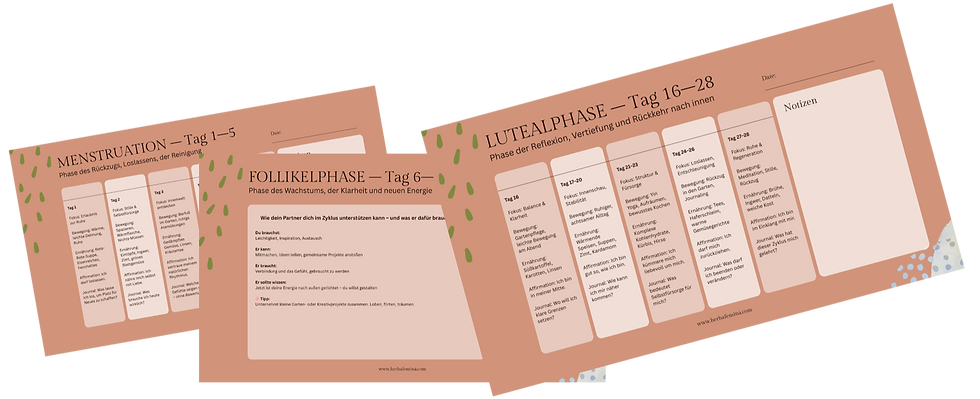
Female boundaries are not static. They change with the menstrual cycle, life phase, and inner capacity.
What feels easy in the first half of the cycle can be intrusive in the luteal phase. The problem isn't the man, but the expectation that women must be available at all times.
Equality arises when this cyclical truth is spoken, without guilt, without justification.
Borders do not divide.
They are sorting.
They protect.
They enable genuine connection.
Those who know and embody their boundaries demonstrate inner security and fundamentally change the dynamics in relationships.
Boundaries without harshness are an attitude:
They maintain respect for yourself.
They show you what feels right for you.
They only allow what deserves to be treated as an equal.
This attitude is the core of female sovereignty.


Comments